Currently Empty: EGP0.00
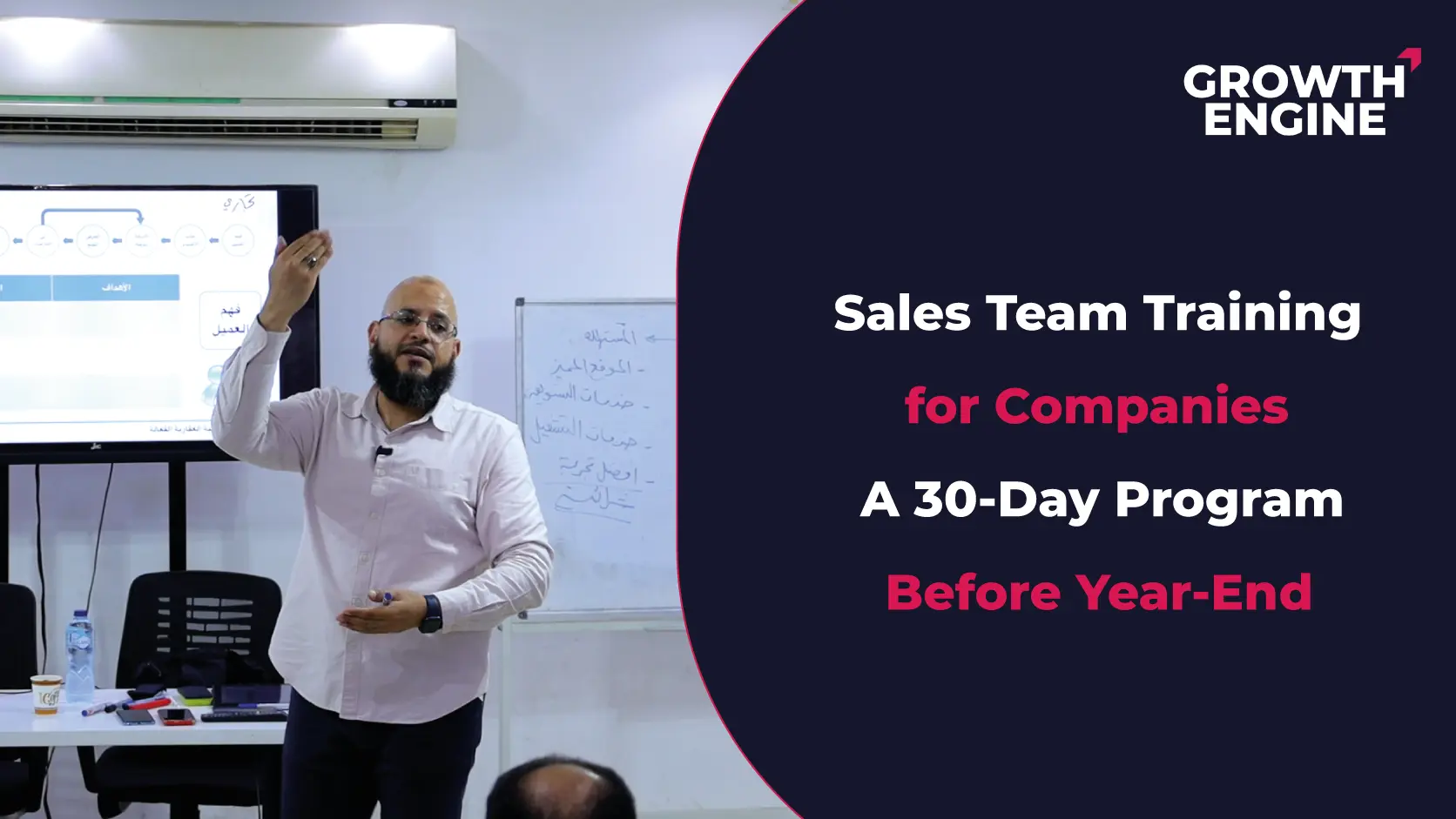
The final weeks of the year can be one of the most important periods for businesses. Sales departments are working to achieve annual targets, convert open opportunities into signed contracts, strengthen customer relationships, and generate revenue before the financial year closes. However, increased pressure does not automatically produce better results. A team may have hundreds of leads in its pipeline and still struggle to close deals because of weak qualification, ineffective follow-ups, poor objection handling, or inconsistent sales processes.
This is where sales team training for companies becomes a strategic investment rather than simply another professional development activity. Instead of asking employees to make more calls or send more emails, businesses need a structured approach that improves how salespeople identify customer needs, communicate value, negotiate, prioritize opportunities, and move prospects toward purchasing decisions.
A focused 30-day training program can help sales managers identify performance gaps, establish consistent selling practices, and equip employees with practical techniques they can immediately apply to active opportunities. It can also create a clearer connection between daily sales activities and the company’s broader revenue objectives.
Growth Engine focuses on practical sales development, modern selling techniques, and sales management skills that help professionals approach commercial challenges with greater structure and confidence. For businesses preparing for year-end, this approach means combining targeted learning with real-world exercises, opportunity reviews, and measurable performance indicators.
The objective is not to guarantee a specific increase in revenue within a month. Sales outcomes depend on factors such as market conditions, pricing, product-market fit, buying cycles, and customer budgets. Instead, the goal is to improve the controllable elements of the sales process so the team can make better decisions and execute more consistently.
In this guide, you will discover a practical 30-day sales team training plan, organized into four weekly phases. Each phase includes actionable exercises, management recommendations, and performance metrics to help your company prepare for the year-end sales season.
Why Sales Team Training Matters Before Year-End
A structured sales training program helps businesses address performance problems before they become more expensive or difficult to resolve.
1. Improve Conversion Rates
A large number of calls or meetings means little if prospects do not progress through the sales funnel. Training helps salespeople ask better questions, qualify opportunities more accurately, communicate relevant benefits, and guide prospects toward clear next steps.
2. Reduce Time Wasted on Unqualified Leads
Sales teams often spend too much time pursuing prospects who lack the budget, authority, urgency, or need to purchase. Effective qualification helps employees identify promising opportunities and allocate their time more intelligently.
3. Strengthen Objection Handling
Price concerns, competing offers, delayed decisions, and requests for additional approvals are common challenges in business sales. Training gives employees a repeatable framework for understanding objections and responding with relevant information instead of immediately offering discounts.
4. Establish a Consistent Sales Process
When every salesperson follows a different approach, managers struggle to identify what works and where opportunities are being lost. A shared sales methodology creates consistency in qualification, discovery, presentations, negotiations, and follow-ups.
5. Improve Year-End Sales Forecasting
A realistic forecast helps managers identify which opportunities are likely to close, which require intervention, and which should be moved into a longer-term pipeline. This allows businesses to focus on achievable outcomes rather than relying on optimistic assumptions.
How to Build a 30-Day Sales Team Training Plan
Before training begins, assess the team’s current performance. The most effective program addresses specific weaknesses instead of delivering generic lessons to everyone.
Step 1: Audit Current Sales Performance
Review the previous 60 to 90 days of sales activity, where sufficient data is available. Examine:
- Number of leads contacted.
- Meetings booked and completed.
- Qualified opportunities created.
- Conversion rates between pipeline stages.
- Average sales cycle length.
- Average deal value and gross margin.
- Discounting patterns.
- Number of stalled opportunities.
- Forecast accuracy compared with actual results.
These metrics should be interpreted together. For example, a salesperson may generate many meetings but few qualified opportunities, suggesting a qualification problem rather than an activity problem.
Step 2: Identify the Most Important Skill Gaps
Connect each performance issue to a specific training objective. If meetings rarely result in proposals, improve discovery and qualification. If proposals frequently stall, focus on value communication, stakeholder alignment, and follow-up discipline.
Step 3: Establish Measurable Objectives
Set realistic goals for the 30-day period. Examples include improving CRM data completeness, increasing the proportion of qualified meetings, reducing opportunities without scheduled next steps, or improving sales-call assessment scores.
Avoid setting arbitrary improvement percentages. Targets should reflect the company’s starting point, sales cycle, market conditions, and available resources.
Step 4: Combine Learning With Practical Application
Use short training sessions, role-playing exercises, recorded-call reviews, deal coaching, and real customer interactions. Each training session should result in an action employees can apply and managers can evaluate.
The 30-Day Sales Training Program for Companies
The following four-week framework can be adapted to different industries, team sizes, and sales cycles.
Week 1: Assess Performance and Establish Strong Sales Fundamentals
The first week focuses on understanding the team’s current capabilities, improving customer qualification, and establishing a consistent sales approach.
Days 1–2: Assess Skills and Review the Pipeline
Begin with a kickoff meeting explaining the program’s objectives and expectations. Review open opportunities, recent wins, lost deals, and stalled prospects.
Ask each salesperson to explain the current status of important opportunities, the customer’s main problem, the decision-making process, and the next agreed action.
Use a structured assessment covering questioning skills, listening, discovery, value communication, objection handling, and follow-up discipline. Position the assessment as a development tool rather than a punitive evaluation.
Days 3–4: Improve Lead Qualification
Train employees to distinguish between general interest and genuine buying potential.
In B2B sales, qualification may involve understanding the company’s size, business challenge, available budget, implementation timeline, decision-makers, and procurement process.
Develop a set of discovery questions tailored to your business. For example:
- What business challenge are you trying to solve?
- How is this problem affecting your current results?
- What solutions have you already considered?
- Who will be involved in the purchasing decision?
- What criteria will determine the final choice?
Have employees practice these questions through simulated discovery calls. The objective is to improve qualification quality without prematurely dismissing prospects who may become viable customers.
Days 5–7: Strengthen the Value Proposition
A strong value proposition explains how a product or service addresses a specific customer problem and why the proposed solution is relevant.
Train employees to connect customer challenges with practical benefits, supporting evidence, and the outcomes the solution is designed to deliver.
Practical exercise: Ask each salesperson to deliver a 60-second value proposition that answers three questions: What problem do we solve? How does our solution help? Why is it relevant to this particular customer?
At the end of the week, review sample pitches and identify the skills that require further development.
Week 2: Develop Selling, Persuasion, and Negotiation Skills
The second week focuses on improving sales conversations and helping employees turn initial interest into qualified commercial opportunities.
Days 8–9: Improve Sales Calls and Discovery Meetings
Teach salespeople to open conversations with a clear reason for contacting the customer and a respectful understanding of their time.
Avoid relying entirely on memorized scripts. Employees should understand the purpose of each question and adapt their conversations to the prospect’s responses.
Practice active listening, relevant follow-up questions, concise explanations, and confirmation of customer needs before presenting a solution.
Managers can review simulated calls using a scorecard that evaluates discovery quality, listening, relevance, and the clarity of agreed next steps.
Days 10–11: Master Objection Handling
Create a list of common objections from recent customer conversations. These may include concerns about pricing, budget limitations, competitor comparisons, implementation risks, and requests to postpone a decision.
Teach employees a four-step response framework:
- Listen carefully without interrupting.
- Ask questions to understand the underlying concern.
- Respond with information relevant to the customer’s needs.
- Agree on a specific next step.
For example, when a prospect says the price is too high, the salesperson should determine whether the issue is limited budget, unclear value, or a comparison with another supplier. Each situation requires a different response.
This approach helps teams protect profitability while maintaining constructive customer relationships.
Days 12–14: Improve Negotiation and Closing Skills
Train employees to negotiate price, scope, delivery timelines, and contract terms without making unnecessary concessions.
If a customer requests a discount, explore whether adjusting the scope, payment schedule, or service package would be more appropriate, provided the proposed terms comply with company policy.
Employees should also learn to recognize genuine buying signals without assuming that every question indicates readiness to sign. Effective closing requires a clear understanding of the customer’s needs, resolved concerns, and agreement on the remaining purchasing steps.
Companies seeking a more structured approach can explore Growth Engine’s Modern Selling Excellence Training to develop practical selling techniques and more effective customer conversations.
Week 3: Optimize Pipeline Management and Sales Productivity
Strong selling skills deliver greater value when employees know which opportunities to prioritize and how to manage them effectively.
Days 15–16: Clean Up and Prioritize the Sales Pipeline
Review every active opportunity and verify its stage, latest customer interaction, outstanding questions, decision-makers, and next scheduled action.
Prioritize opportunities using evidence-based criteria, such as customer fit, business urgency, access to decision-makers, budget alignment, purchasing timelines, and confirmed customer engagement.
Every active opportunity should have a defined next step and an appropriate follow-up date. Opportunities lacking essential information should have a qualification plan or be moved into a suitable longer-term follow-up process.
Days 17–18: Improve Customer Follow-Ups
Some deals are lost because follow-ups are inconsistent or provide no additional value.
Train employees to write relevant follow-up messages that reflect the customer’s priorities, summarize important discussion points, answer outstanding questions, and propose a clear next step.
Depending on the opportunity, this might involve arranging a meeting with a decision-maker, sharing a revised proposal, scheduling a product demonstration, or reviewing technical requirements.
Follow-up frequency should reflect customer preferences, deal complexity, and the buying process rather than a rigid schedule applied to every prospect.
Days 19–21: Strengthen Forecasting and Deal Planning
Teach employees and managers to distinguish total pipeline value from revenue that is realistically expected to close.
Forecasts should be based on evidence, including stakeholder engagement, confirmed business needs, progress through decision stages, commercial discussions, and a credible closing timeline.
Establish a weekly deal-review meeting covering:
- The highest-priority opportunities.
- Expected closing dates and supporting evidence.
- Obstacles requiring managerial support.
- Agreed next actions.
- Risks that could delay purchasing decisions.
When an opportunity is unlikely to close before year-end, record that risk honestly instead of inflating the forecast.
Growth Engine’s Sales Management Excellence course is relevant for organizations seeking to strengthen planning, forecasting, performance monitoring, and sales team leadership.
Week 4: Apply Skills and Prepare for the Year-End Sales Season
The final week moves the team from structured learning to focused execution on real opportunities.
Days 22–24: Apply Training to Active Deals
Select a group of important opportunities and ask each salesperson to prepare a deal plan covering the customer’s business problem, decision-makers, likely objections, outstanding requirements, and next steps.
Managers should review these plans in short coaching sessions. Useful questions include: What information is still missing? What is preventing the customer from deciding? What evidence supports the expected closing date?
This approach turns coaching into practical problem-solving rather than general advice.
Days 25–26: Simulate Difficult Sales Situations
Organize role-playing exercises based on realistic scenarios, such as a prospect comparing multiple suppliers, a purchasing committee with conflicting priorities, a budget objection, or a last-minute discount request.
Evaluate employees against consistent criteria: listening, questioning, value communication, objection handling, negotiation discipline, and agreement on next steps.
Provide specific feedback immediately after each exercise and allow employees to repeat the scenario using the suggested improvements.
Days 27–28: Build the Year-End Execution Plan
Translate revenue objectives into daily and weekly priorities.
Start with qualified opportunities that have a credible chance of progressing within the remaining time. Then allocate appropriate attention to existing customers, renewals, and expansion opportunities where additional purchases genuinely address customer needs.
Year-end pressure should not justify unrealistic promises, poor qualification, or aggressive discounting that damages margins. A poorly qualified deal may temporarily increase reported revenue while creating delivery problems, customer dissatisfaction, or future retention risks.
Days 29–30: Evaluate Progress and Plan Continued Development
Compare the team’s performance with the baseline established on Day 1.
Review pipeline quality, follow-up consistency, sales-call assessments, forecast accuracy, conversion rates, and employee confidence in applying the trained skills.
Create an individual development plan for each salesperson, identifying two or three priorities for the next 60 to 90 days.
The training program should become part of an ongoing routine that includes coaching, deal reviews, skill refreshers, and learning from both successful and unsuccessful opportunities.
How to Measure the Success of a Sales Training Program
An effective evaluation combines learning outcomes, activity indicators, pipeline improvements, and commercial results.
Key Sales Performance Indicators
Conversion rate: Measure the percentage of opportunities progressing between defined pipeline stages or becoming closed deals.
Sales cycle length: Track the time required to move opportunities from a consistently defined starting point to a closed outcome.
Pipeline quality: Measure how many active opportunities have updated information, confirmed needs, identified decision-makers, and clear next steps.
Forecast accuracy: Compare projected revenue with actual results over the same period.
Average deal value and gross margin: Determine whether sales improvements are producing commercially healthy deals rather than revenue growth driven primarily by discounts.
Skill application: Use call reviews, role-playing scorecards, and proposal assessments to determine whether employees are applying the techniques covered during training.
Build a simple dashboard showing each metric, its baseline, the target, the current result, and the person responsible for improvement.
Remember that revenue may not change immediately after training, particularly when the sales cycle extends beyond 30 days. Early improvements in qualification, pipeline visibility, and conversation quality can still indicate that the program is addressing the right problems.
Common Mistakes to Avoid When Training Sales Employees
Relying Entirely on Classroom Learning
Understanding a technique does not automatically mean an employee can apply it under pressure. Combine instruction with role-playing, call reviews, live practice, and targeted feedback.
Giving Every Employee Identical Training
New salespeople may need help with qualification and discovery, while experienced representatives may benefit more from negotiation and complex deal management. Customize training according to demonstrated skill gaps.
Measuring Activity Instead of Effectiveness
More calls and meetings do not necessarily produce better results. Evaluate the quality of interactions, the suitability of prospects, and progress through the pipeline alongside activity volume.
Using Discounts as the Default Solution
Discounting can sometimes be appropriate, but it should not replace value communication and negotiation. Teach employees to understand the objection before offering concessions.
Ending Development After 30 Days
Skills deteriorate when they are not practiced. Continue with weekly deal reviews, individual coaching, periodic assessments, and targeted refresher sessions.
How to Choose the Right Sales Training Program for Your Company
When comparing sales training programs for companies, evaluate more than course price or total training hours. The right program should address your team’s actual commercial challenges and provide techniques that employees can apply immediately.
Look for relevant coverage of lead qualification, consultative selling, objection handling, negotiation, pipeline management, forecasting, and sales leadership.
Assess the practical learning methods as well. Role-playing, realistic case studies, coaching, and performance assessments can help employees translate concepts into workplace behavior.
Before selecting a program, define what success should look like. Are you trying to improve discovery meetings, reduce stalled opportunities, develop sales managers, or establish a consistent selling methodology? Clear objectives make it easier to select appropriate training and evaluate its business value.
If you are comparing available options in Egypt, Growth Engine’s guide to the Best Sales Courses in Egypt for 2026 can help you identify the factors worth considering before choosing a learning path.
Conclusion: Prepare Your Sales Team Before Year-End Pressure Peaks
A 30-day sales team training program provides a practical framework for assessing performance, improving selling skills, optimizing pipeline management, and preparing for the year-end sales season.
The strongest approach connects every training activity to a specific business challenge, a practical exercise, and a measurable indicator. Start by analyzing your team’s performance, prioritize the skills most likely to influence results, and implement the four weekly phases systematically.
Do not wait until annual targets are at risk to begin developing your team. Early preparation creates more time to identify weaknesses, practice new techniques, and improve the quality of sales execution.
Growth Engine offers sales development and management learning opportunities for professionals seeking to improve their commercial capabilities. Explore the available courses and identify the training that best aligns with your company’s objectives.
Start your 30-day plan with a clear baseline, a committed management team, and a practical schedule. Build a sales team that approaches year-end with stronger skills, better pipeline visibility, and more disciplined execution.
Frequently Asked Questions
1. What is sales team training for companies?
Sales team training for companies is a structured development process that improves employees’ ability to qualify prospects, understand customer needs, communicate value, negotiate, and close deals. Effective programs align these skills with the company’s sales objectives and performance metrics.
2. Can sales team performance improve within 30 days?
Yes, a focused 30-day program can improve sales conversations, qualification practices, follow-up discipline, and pipeline visibility. Revenue improvements may take longer, particularly when the business has an extended sales cycle.
3. What should a sales training program include?
A comprehensive program should cover lead qualification, consultative selling, discovery questions, objection handling, negotiation, closing, pipeline management, follow-ups, and performance measurement. The emphasis should depend on the team’s current weaknesses and commercial priorities.
4. How do I create a 30-day sales team training plan?
Begin with a performance assessment, identify priority skill gaps, and establish measurable objectives. Divide the month into weekly phases covering sales fundamentals, selling skills, pipeline management, and practical execution on active opportunities.
5. How can I measure sales employee training effectiveness?
Measure changes in conversion rates, pipeline quality, sales cycle length, forecast accuracy, and the application of trained skills. Compare results with a baseline and account for market conditions and the time required for deals to close.
6. What is the difference between sales training and sales management training?
Sales training focuses on customer conversations, qualification, persuasion, negotiation, and closing. Sales management training focuses more on planning, forecasting, target allocation, performance monitoring, and team leadership.
7. How can I help my sales team close more deals?
Improve qualification, identify why opportunities stall, strengthen objection handling, and ensure every qualified opportunity has a clear next step. Regular deal coaching can also help salespeople address specific obstacles before opportunities are lost.
8. Is sales team training suitable for small and medium-sized businesses?
Yes. Small and medium-sized businesses can adapt training to their budgets, team sizes, and sales processes. A focused program targeting the most important skill gaps may be more practical than a broad training initiative.
9. How do I choose the best sales training program for my company?
Compare course content with your business objectives, evaluate the practical exercises and assessment methods, and confirm that the program addresses your team’s specific skill gaps. Define expected outcomes before enrollment so you can assess its relevance and value.
10. How can I prepare my sales team for the year-end sales season?
Review the pipeline early, prioritize qualified opportunities, identify obstacles requiring management support, and strengthen negotiation and follow-up skills. Use realistic forecasts and disciplined execution to pursue year-end opportunities without sacrificing profitability or customer relationships.