Currently Empty: EGP0.00
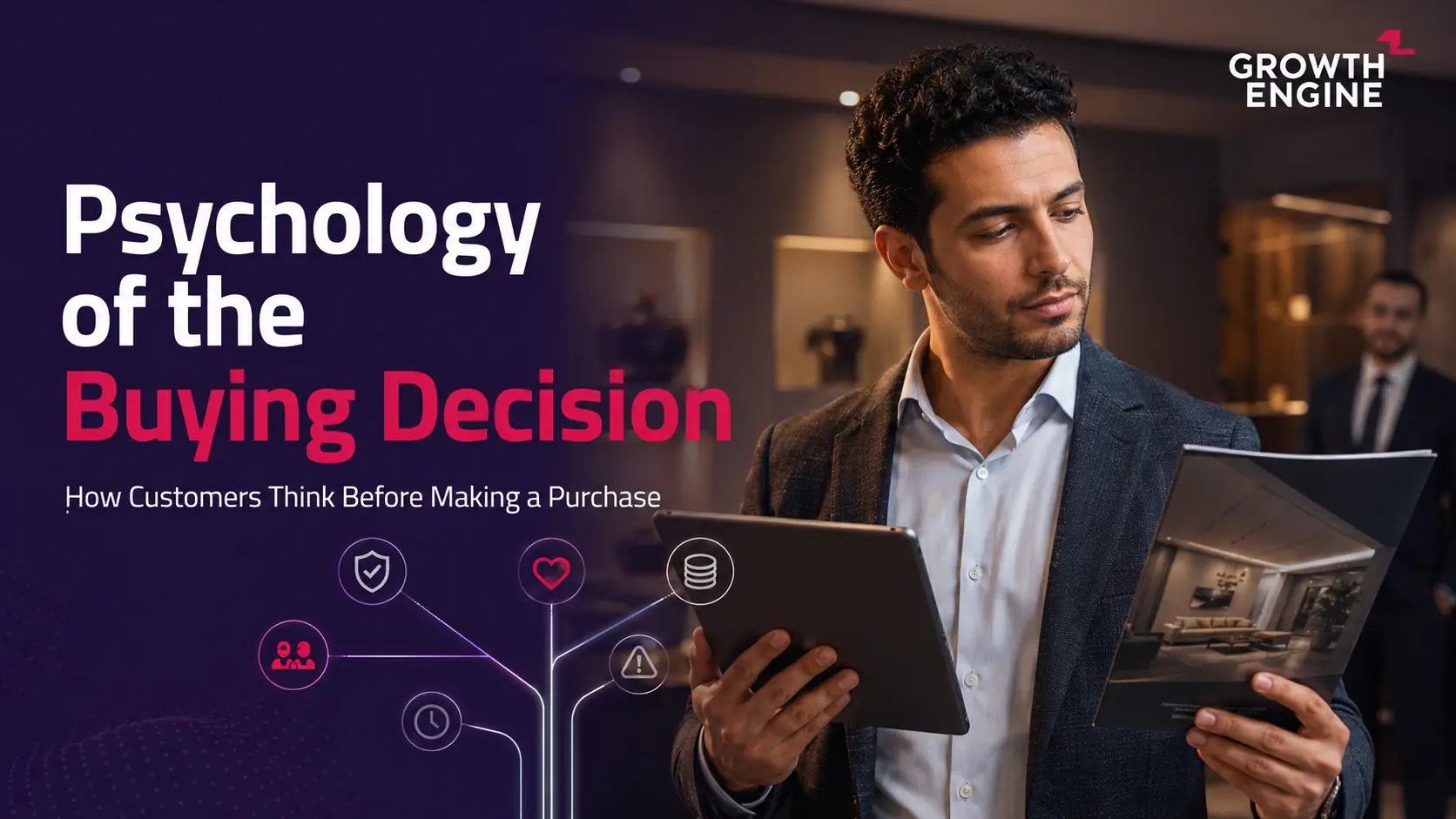
Customers buy when a solution connects to a real motivation, the perceived risk feels acceptable, and the seller or brand appears trustworthy. Emotion creates attention and desire; logic and evidence then help justify the decision and reduce uncertainty.
Why does one customer choose a specific product while another rejects the same offer? Why do some prospects quickly trust a salesperson and move forward, while others hesitate even when the product seems like the right choice?
The answer is not always related to price, features, or timing. Behind every purchase decision is a complex combination of emotions, experiences, beliefs, and psychological triggers. Understanding buying decision psychology allows sales professionals to understand what truly influences customers and how they evaluate choices before committing.
In modern sales, success is no longer determined only by product knowledge or persuasive presentations. Customers today have access to more information than ever before. They compare alternatives, research companies, read reviews, and make opinions before speaking with a salesperson.
Because of this, successful sales professionals need to understand the person behind the purchase.
Customers do not simply buy products or services. They buy solutions, outcomes, confidence, convenience, security, and the feeling that they are making the right decision.
At Growth Engine, we believe that professional selling begins with understanding human behavior. The best salespeople are not those who talk the most—they are the ones who understand customer motivations, ask the right questions, and guide buyers through the decision-making process.
This guide explains how customers think before purchasing, the role emotions and logic play in buying decisions, the psychology behind successful sales conversations, and how sales professionals can use these insights to improve persuasion and build stronger customer relationships.
What Is Buying Decision Psychology?
Buying decision psychology refers to the study of the mental and behavioral factors that influence how customers choose whether to purchase a product, service, or solution.
A purchase decision does not happen instantly. Instead, customers usually move through several psychological stages:
- Recognizing a need.
- Searching for possible solutions.
- Comparing available options.
- Evaluating risks.
- Building confidence.
- Making the final decision.
Throughout this process, customers are influenced by many factors, including:
- Their personal goals.
- Previous experiences.
- Trust in the company.
- Perceived value.
- Emotional connection.
- Level of risk involved.
This is why successful salespeople do not only ask:
“How can I sell this product?”
They ask:
“Why would this customer want this solution?”
That shift in thinking separates traditional selling from modern consultative selling.
How the Human Brain Makes Buying Decisions
Many customers believe they make purchasing decisions based entirely on logic.
However, human decisions are usually influenced by both emotional and rational thinking.
When customers first encounter a product or service, their brain automatically evaluates questions such as:
- Can I trust this company?
- Is this solution relevant to my situation?
- Will this improve my life or business?
- Is the investment worth it?
- What happens if I make the wrong decision?
These questions often happen before the customer begins analyzing technical details.
For example, someone buying a home may first feel attracted to a property because it represents comfort, security, or a better lifestyle. After that emotional connection is created, they begin looking for logical reasons such as location, payment plans, construction quality, and investment potential.
The same principle applies across industries.
Customers usually feel the value first, then search for information that confirms their decision.
This is why understanding the subconscious mind in sales is essential for professionals who want to influence decisions ethically.
Emotional vs. Rational Buying Decisions
A common misconception in sales is that customers buy only because of logical reasons.
In reality, most decisions combine emotional motivation with logical justification.
Emotional Drivers
Emotions often create the initial desire to buy.
Examples include:
- Feeling secure.
- Improving lifestyle.
- Saving time.
- Achieving success.
- Reducing stress.
- Gaining confidence.
For example, a customer purchasing a premium service is not only buying the service itself. They may be buying peace of mind, better results, or the confidence that comes from choosing a reliable solution.
Rational Drivers
Logic helps customers justify their decision.
These factors include:
- Price.
- Features.
- Quality.
- Return on investment.
- Comparison with alternatives.
- Technical details.
A professional salesperson understands that both elements are necessary.
If you only focus on emotions, customers may feel interested but uncertain.
If you only focus on logic, customers may understand the product but feel no motivation to act.
The strongest sales conversations combine both.
Why Understanding Customer Psychology Improves Sales Performance
Understanding customer behavior gives sales professionals a major advantage.
Creating More Effective Conversations
When you understand what matters to customers, you can communicate in a way that feels relevant.
For example:
An investor may care about growth potential and financial returns.
A family buying a home may care more about safety, comfort, and location.
The same product can be presented differently depending on the customer’s motivation.
Creating Personalized Sales Experiences
Customers do not want generic sales messages.
They want solutions that match their specific situation.
A salesperson who understands customer psychology can adapt their approach by focusing on:
- Individual goals.
- Personal concerns.
- Buying motivations.
- Decision-making style.
This creates a stronger connection and increases the chance of conversion.
Handling Objections More Effectively
Many salespeople see objections as problems.
However, objections often reveal important psychological concerns.
For example:
“I need to think about it.”
May actually mean:
- I need more confidence.
- I don’t understand the value yet.
- I am worried about risk.
- I need more information.
When sales professionals understand the psychology behind objections, they can respond with clarity instead of pressure.
The Main Buying Motivations Behind Customer Decisions
Every customer has a reason behind their purchase.
Although motivations vary between industries and individuals, several common drivers appear in most buying decisions.
1. Solving a Problem
Most customers are not searching for products—they are searching for solutions.
Examples:
- A business buying software wants better efficiency.
- A homeowner wants comfort and stability.
- An investor wants financial growth.
The more clearly a salesperson connects the solution to the customer’s problem, the easier the decision becomes.
2. Gaining More Value
Customers do not always choose the cheapest option.
They choose the option that provides the strongest perceived value.
Value may include:
- Better results.
- Higher quality.
- Lower risk.
- Long-term benefits.
- Greater convenience.
Successful sales professionals focus on outcomes rather than competing only on price.
3. Trust and Confidence
Trust is one of the strongest influences on buying behavior.
Even an excellent product can fail if customers do not trust:
- The salesperson.
- The company.
- The information provided.
- The promised results.
Building credibility is therefore a core part of modern selling.
4. Achieving Personal or Professional Goals
Many purchases are connected to bigger ambitions.
Customers may want to:
- Grow their business.
- Improve their lifestyle.
- Save time.
- Build financial security.
- Achieve personal success.
Understanding these goals allows salespeople to create conversations that feel meaningful.
Applying Buying Decision Psychology in Real Sales Conversations
Understanding customer psychology is valuable, but the real impact comes from applying it during actual sales interactions.
Professional salespeople do not rely on memorized scripts or identical presentations for every customer. Instead, they use buying decision psychology to understand customer behavior, identify motivations, and guide conversations toward confident decisions.
The goal is not to manipulate customers into buying. The goal is to help them recognize the value of a solution that genuinely fits their needs.
1. Discover the Motivation Before Presenting the Solution
One of the most common mistakes in sales is presenting too early.
Many salespeople immediately start discussing:
- Features.
- Pricing.
- Offers.
- Product specifications.
However, customers do not become interested because they hear information. They become interested when they understand how the solution connects to their goals.
Before presenting your offer, focus on discovery questions:
- What made you start looking for this solution?
- What result are you hoping to achieve?
- What is the biggest challenge you are currently facing?
- What matters most when choosing between options?
These questions reveal the real motivation behind the purchase.
For example, a customer looking for a property may say they need a larger apartment, but the deeper motivation could be providing more comfort for their family or making a long-term investment.
Understanding the motivation allows you to create a much stronger sales conversation.
2. Use Value-Based Communication Instead of Selling Language
Customers do not want to feel like they are being pushed into a purchase.
They want to understand why a solution is valuable for their specific situation.
Compare these two approaches:
Selling-focused approach:
“Our product has many advanced features.”
Value-focused approach:
“This solution will help you reduce the challenges you currently face and achieve the results you are looking for.”
The second approach connects the product to the customer’s reality.
This is the foundation of effective sales psychology—helping customers see personal value instead of simply listing advantages.
3. Understand the Role of the Subconscious Mind in Sales
The subconscious mind in sales plays a major role in how customers form impressions and evaluate trust.
Before customers analyze details, they often create an initial feeling about:
- The salesperson’s professionalism.
- The company’s credibility.
- The quality of communication.
- Whether they feel understood.
This explains why two salespeople can present the same product but achieve completely different results.
One may create confidence and connection, while the other may create hesitation.
Customers may not remember every detail from a conversation, but they usually remember how the interaction made them feel.
For sales professionals who want to understand how psychological factors influence customer decisions, Growth Engine’s subconscious sales mastery training provides practical frameworks for understanding buyer behavior, improving communication, and creating more effective sales interactions.
4. Reduce Customer Risk and Uncertainty
Every purchase decision includes some level of perceived risk.
Even interested customers may think:
- Is this the right choice?
- Am I paying the right price?
- What if I choose the wrong option?
- Is there a better alternative?
Professional salespeople do not ignore these concerns.
They help customers reduce uncertainty by providing:
- Clear information.
- Real examples.
- Customer success stories.
- Transparent processes.
- Honest expectations.
The lower the perceived risk, the easier it becomes for customers to move forward.
5. Make Customers Part of the Decision Process
One of the strongest persuasion techniques is allowing customers to participate in reaching the conclusion.
Instead of saying:
“This is definitely the best option for you.”
Try saying:
“Based on what you shared, this option seems to match your priorities. How does it feel compared with the alternatives?”
Or:
“Let’s compare these options and see which one supports your goals better.”
When customers feel ownership over the decision, they become more confident and less resistant.
Common Mistakes That Prevent Successful Persuasion
Even experienced sales professionals can make mistakes that reduce their ability to influence buying decisions.
Selling Before Building Trust
Trust comes before persuasion.
If customers feel that the only goal is closing the deal, they become defensive.
Successful salespeople first focus on understanding, helping, and creating credibility.
Using the Same Approach With Every Customer
Every customer has different motivations.
One buyer may prioritize price.
Another may prioritize quality.
Another may care most about speed, convenience, or security.
Using the same message with everyone reduces your effectiveness.
Personalization is one of the strongest applications of customer psychology in sales.
Focusing on Features Instead of Outcomes
Customers are rarely excited by features alone.
They care about results.
Instead of explaining what a product has, explain what it helps them achieve.
For example:
A real estate customer does not only buy square meters.
They buy:
- Comfort.
- Security.
- Lifestyle.
- Future value.
A business customer does not only buy software.
They buy:
- Efficiency.
- Growth.
- Time savings.
- Better performance.
Ignoring the Post-Purchase Experience
The customer relationship does not end after the sale.
Strong follow-up creates:
- Customer loyalty.
- Repeat purchases.
- Referrals.
- Long-term trust.
Successful sales organizations understand that every customer interaction affects future growth.
Applying Buying Psychology in Real Estate Sales
Real estate is one of the clearest examples of how psychology influences buying decisions.
A property purchase involves significant financial commitment, meaning customers need more than information—they need confidence.
Real estate buyers are not simply purchasing:
- A house.
- An apartment.
- A commercial unit.
They are purchasing:
- Security.
- A future lifestyle.
- Financial stability.
- A sense of achievement.
This is why successful real estate sales professionals must understand the emotions behind customer questions.
When a buyer asks:
“How much is the property?”
The deeper question may be:
“Is this investment worth my money?”
When a buyer says:
“I need time to think.”
The real concern may be:
“I am not completely convinced yet.”
Understanding the meaning behind customer words is one of the most important real estate sales skills.
Professionals looking to apply these principles in the property market can benefit from Growth Engine’s Real Estate Sales Mastery Training, which focuses on customer psychology, modern selling techniques, objection handling, and improving real estate sales performance.
The Most Important Sales Skills Based on Customer Psychology
Understanding psychology is only valuable when combined with practical sales skills.
The strongest sales professionals continuously improve:
Active Listening
Listening helps you discover customer needs and create relevant solutions.
Asking Strategic Questions
The right questions uncover hidden motivations.
Emotional Intelligence
Understanding customer emotions helps create stronger relationships.
Objection Management
Professional objection handling transforms hesitation into confidence.
Closing Skills
Knowing when and how to ask for commitment is essential for consistent results.
To develop these abilities systematically, sales professionals can explore Essential Sales Skills and How to Develop Them Professionally, which covers the core capabilities needed to improve communication, persuasion, and overall sales performance.
Related Guides for Practical Application
- The art of selling and persuasion
- Questions that uncover customer needs
- Understanding customer objections
- Buying readiness signals
- Salesmanship for the Subconscious Mind course
- Essential sales skills
Recommended Video from Growth Engine Academy
Content Review and Experience
This article was reviewed by Growth Engine Academy’s sales training and consulting team. Since 2013, the academy has trained more than 9,500 professionals and worked with over 250 companies, so the recommendations emphasize practical application rather than theory alone.
Conclusion
Understanding buying decision psychology is one of the biggest advantages modern sales professionals can develop.
Customers do not make decisions based only on information. Their choices are influenced by emotions, motivations, trust, experiences, and their perception of value.
When salespeople understand customer psychology, they stop focusing only on selling products and start creating meaningful solutions.
By mastering sales psychology, understanding the subconscious factors behind decisions, and developing stronger persuasion skills, professionals can build better relationships, handle objections more effectively, and achieve more consistent results.
At Growth Engine, we help sales professionals and teams develop modern selling capabilities through practical training programs focused on buyer behavior, communication, persuasion, negotiation, and closing strategies.
Investing in sales skills means investing in the ability to understand people—and understanding people is the foundation of successful selling.
Frequently Asked Questions
What is buying decision psychology?
Buying decision psychology is the study of the mental and emotional factors that influence how customers evaluate options and decide whether to purchase a product or service.
Why is sales psychology important?
Sales psychology helps professionals understand customer motivations, communicate more effectively, and create buying experiences based on trust and value.
Do customers buy based only on logic?
No. Most purchase decisions involve both emotional motivation and logical evaluation. Customers often feel the value first and then use logic to justify the decision.
What are the main buying motivations?
Common buying motivations include solving problems, gaining value, reducing risk, achieving goals, and building confidence in the purchase decision.
How does the subconscious mind affect sales?
The subconscious mind influences first impressions, trust, emotional responses, and the way customers evaluate sales interactions.
How can salespeople improve persuasion skills?
Salespeople can improve persuasion by asking better questions, listening actively, understanding customer needs, and focusing on value rather than pressure.
Why do customers hesitate before buying?
Customers often hesitate because of uncertainty, perceived risk, lack of information, or the need for more confidence before making a commitment.
Can buying psychology be learned?
Yes. Customer psychology can be developed through training, practice, and understanding behavioral principles that influence decisions.
How does customer psychology help real estate sales?
It helps real estate professionals understand buyer motivations, reduce uncertainty, handle objections, and create stronger conversations with property buyers.
How does Growth Engine help sales professionals?
Growth Engine provides practical sales training that helps professionals improve customer understanding, persuasion techniques, communication skills, and modern sales performance.