Currently Empty: EGP0.00
Sales Call Script Guide: What to Say From the First Second to the Next Step
September 17, 2026
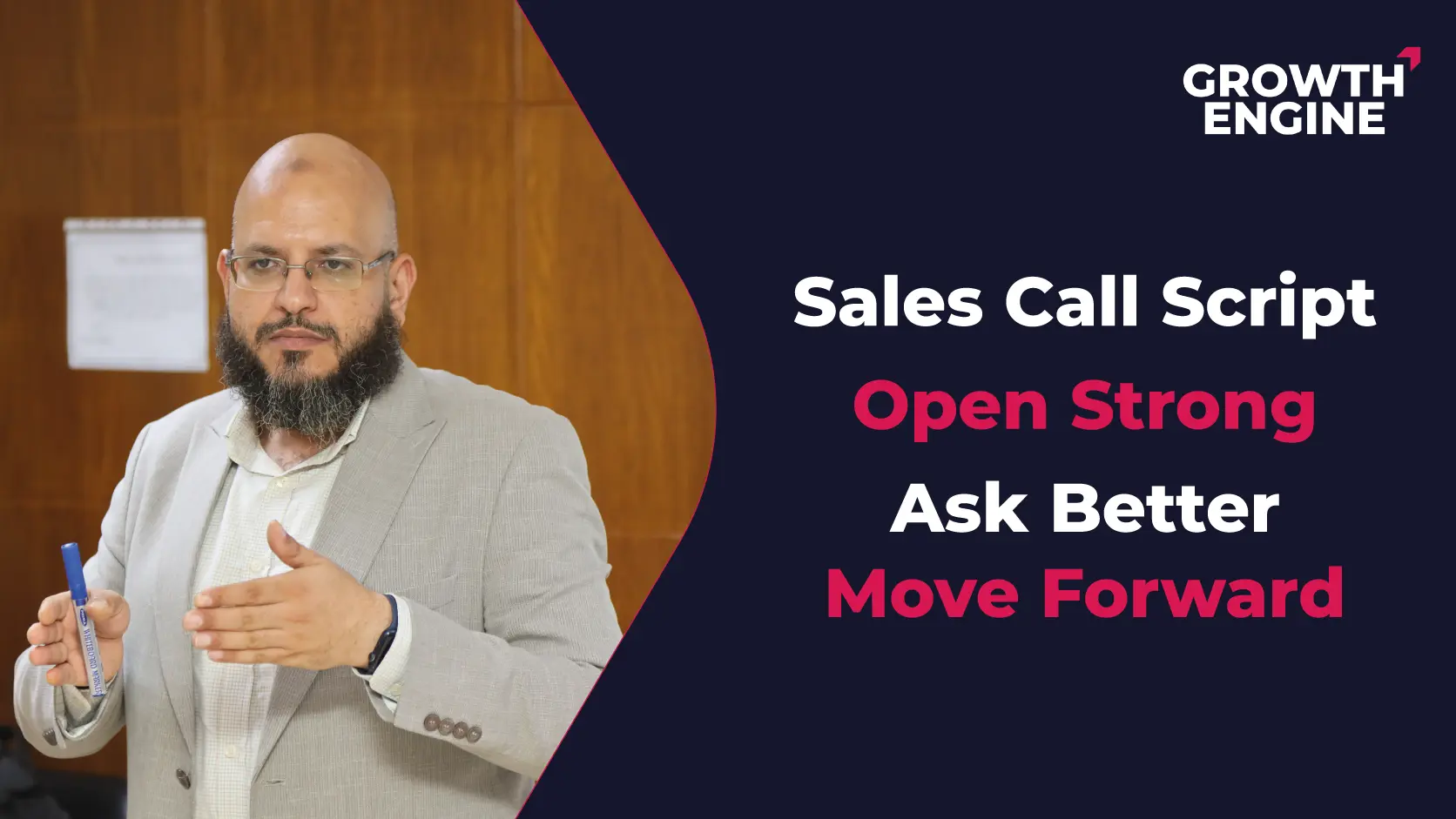
A sales call can be won or lost within the first few seconds.
That does not mean a salesperson needs a perfect opening line or a script that sounds rehearsed. In fact, the opposite is usually true. Customers can quickly recognize when someone is simply reading a script rather than having a genuine conversation.
A strong Sales Script is not designed to turn salespeople into robots. It gives them a reliable structure they can use to control the conversation, ask better questions, understand customer needs, communicate value, handle objections, and finish the call with a clear next step.
This is particularly important in phone sales because the salesperson cannot rely on body language, facial expressions, or visual demonstrations. The words, tone, timing, and questions used during the conversation become much more important.
Whether you are a new salesperson, a telesales representative, a sales manager, or someone looking for a practical telesales course, understanding how to structure a sales call can significantly improve your performance.
This Sales Call Script Guide explains what to say from the opening seconds of the call through qualification, needs discovery, value presentation, objection handling, and closing. More importantly, it explains why each stage matters and how to make your script sound natural rather than mechanical.
What Is a Sales Call Script?
A sales call script is a structured framework that helps a salesperson know how to guide a conversation with a potential customer.
It can include:
- An opening statement
- A reason for calling
- Qualification questions
- Discovery questions
- Value statements
- Objection responses
- Closing questions
- A clear next step
However, a good script should not force the salesperson to repeat the same sentences word for word.
Think of it as a conversation map, not a speech.
For example, instead of saying:
“Hello, I am calling to tell you about our amazing product and its many benefits.”
A stronger approach would be:
“Hi Ahmed, this is Omar from the sales team. I’m reaching out because you recently asked about our service. Do you have two minutes so I can understand what you’re looking for?”
The second version creates context and immediately moves toward a conversation.
The First 10 Seconds: How to Start the Call
The opening is one of the most important parts of any sales call.
Your objective is not to sell immediately.
Your objective is to earn enough attention to continue the conversation.
A strong opening usually contains four elements:
- Your name
- Your company
- The reason for the call
- A simple permission-based question
For example:
“Hi Sarah, this is Daniel from the sales team at ABC. You recently requested information about our service, so I wanted to follow up and understand what you need. Is now a good time for a quick conversation?”
This sounds more natural than launching directly into a product pitch.
Avoid Long Introductions
One common mistake is spending the first 30–60 seconds explaining the company.
The customer usually does not care about your company history at this stage.
They want to know:
Why are you calling me, and is this relevant to me?
Keep the opening short and move toward the customer’s situation.
Create Context Before Asking Questions
Once the customer agrees to continue, establish a simple context for the conversation.
You can say:
“Perfect. I’d like to ask you a couple of questions first so I can understand what you’re looking for and then explain whether our solution would actually be suitable.”
This sentence does something important: it sets expectations.
The customer now understands that the salesperson is not going to immediately pressure them into buying.
That creates space for a more consultative conversation.
Discover the Customer’s Real Need
One of the most important phone sales skills is the ability to ask questions and actually listen to the answers.
Many salespeople ask questions simply because the script tells them to.
Instead, every question should have a purpose.
Start with broad questions:
- “What are you currently using?”
- “What are you looking for?”
- “What made you start looking for a solution now?”
- “What is the biggest challenge you’re facing?”
Then move toward more specific questions.
For example:
“You mentioned that response time is a problem. How is that affecting your business today?”
This takes the conversation from a general problem to a measurable business impact.
Listen for the Problem Behind the Problem
Customers often describe symptoms rather than the real issue.
A customer might say:
“The price is too high.”
But the actual concern might be:
- They do not understand the value.
- They are comparing you with a cheaper alternative.
- They are uncertain about the return.
- They are not the final decision-maker.
Your job is not to argue with the statement.
Your job is to understand what is behind it.
Qualify the Opportunity
Not every lead is ready to buy.
A strong Sales Script should therefore include qualification questions.
You want to understand factors such as:
- Need
- Budget
- Timing
- Decision-making authority
- Current solution
- Urgency
For example:
“When would you ideally like to have this solved?”
Or:
“Apart from yourself, is anyone else involved in making the final decision?”
These questions help determine whether the opportunity is worth pursuing and what the next step should be.
Qualification should feel like a conversation rather than an interrogation.
Avoid asking ten questions one after another.
Instead, listen to the customer’s answer and use it to decide what to ask next.
Move From the Problem to the Value
Once you understand the customer’s situation, connect your solution directly to what they told you.
This is where many salespeople make another mistake.
They start listing features.
For example:
“Our platform has automated reports, advanced dashboards, CRM integration, notifications, analytics, and…”
The customer may hear a lot of information without understanding why any of it matters.
Instead, connect the feature to the customer’s specific problem.
For example:
“Since you mentioned that your team spends several hours each week preparing reports, the automated reporting feature could eliminate much of that manual work.”
The structure is simple:
Customer problem → Relevant solution → Business value
That is much more persuasive than a generic product presentation.
Do Not Turn the Call Into a Presentation
A sales call should remain a two-way conversation.
A useful rule is:
Ask → Listen → Clarify → Recommend.
Not:
Talk → Talk → Talk → Ask for the sale.
If the customer is speaking more than you, that is often a good sign.
Use short responses to encourage them:
- “I understand.”
- “Tell me more about that.”
- “What happened next?”
- “Why is that important for you?”
- “How are you handling that today?”
These small phrases can uncover valuable information.
How to Handle “Send Me the Details”
“Send me the details” is one of the most common statements in phone sales.
The worst response is:
“Sure, I’ll send everything over.”
Why?
Because the conversation ends without discovering whether the customer is actually interested.
Instead, ask a follow-up question:
“Absolutely. Before I send it, may I ask what specifically you’d like me to focus on?”
Or:
“Of course. Are you mainly interested in pricing, features, or how the solution would fit your situation?”
Now you have an opportunity to understand intent.
You can also establish a follow-up:
“I’ll send that over today. Would tomorrow afternoon be a good time for us to review it together?”
The goal is not to prevent the customer from receiving information.
The goal is to avoid ending the sales process with an undefined “I’ll get back to you.”
Handling Sales Objections
Objections are a normal part of selling.
Price, timing, competition, uncertainty, and internal approval are all common concerns.
A useful objection-handling structure is:
Listen → Acknowledge → Clarify → Respond → Confirm
For example:
Customer:
“Your price is higher than another company.”
Salesperson:
“I understand. When you say the price is higher, are you comparing the same scope and features, or is there a specific part of our offer that concerns you?”
This response does not become defensive.
It opens the conversation.
For more advanced negotiation techniques, sales professionals can also develop their skills through dedicated training in sales negotiation skills.
Building Trust During the Call
Trust is not created by saying, “You can trust us.”
It is created through the way the salesperson communicates.
Useful trust-building behaviors include:
- Being honest about whether the product is suitable
- Avoiding exaggerated promises
- Asking relevant questions
- Admitting when you do not know something
- Following through on commitments
- Respecting the customer’s time
For example, saying:
“Based on what you’ve told me, I’m not sure our solution is the best fit for your current situation.”
may sound like a lost sale, but it can actually increase credibility.
The customer realizes that the salesperson is trying to solve a problem rather than simply force a transaction.
For a deeper look at this topic, see building customer trust.
How to Close the Sales Call
Closing does not always mean asking:
“Are you ready to buy?”
Sometimes the appropriate close is simply agreeing on the next step.
Depending on the customer’s situation, the next step could be:
- A product demonstration
- Sending a proposal
- A second call
- Speaking with a decision-maker
- A site visit
- A consultation
- Completing an application
- Making the purchase
Use a specific question:
“Based on what we discussed, would it make sense to schedule a demonstration?”
Or:
“Would Tuesday or Wednesday work better for the next conversation?”
Specific questions make it easier for the customer to move forward.
A Complete Sales Call Script Example
Here is a simplified example that combines the framework:
Opening:
“Hi Ahmed, this is Michael from ABC. You recently requested information about our service. Do you have two minutes for a quick conversation?”
Context:
“Great. I’d like to understand what you’re looking for first, then I can explain whether our solution makes sense for you.”
Discovery:
“What are you currently using?”
“What would you most like to improve?”
“How is that issue affecting you today?”
Qualification:
“When would you ideally like to solve this?”
“Who else is involved in the decision?”
Value:
“Based on what you’ve told me, the main benefit for you would be reducing the manual work your team currently handles.”
Objection:
“I understand that price is a concern. Can I ask what you’re comparing our offer against?”
Close:
“It sounds like the next useful step would be a short demonstration. Would tomorrow afternoon work for you?”
Notice that this is not a rigid script.
The salesperson has a structure, but the actual conversation changes depending on the customer’s answers.
Train Salespeople to Use Scripts Naturally
Writing a good script is only the first step.
Salespeople need to practice it.
Role-playing is particularly useful because it allows sales representatives to experience different customer scenarios before facing them in real conversations.
Managers can create scenarios such as:
- Interested customer
- Price-sensitive customer
- Customer comparing competitors
- Customer with no urgency
- Customer who wants information only
- Customer who needs approval
- Difficult or impatient customer
The salesperson should practice responding without simply memorizing sentences.
For teams working in property sales, specialized programs such as real estate sales training can help sales professionals develop more specialized selling skills.
Common Sales Script Mistakes
Even a well-designed script can fail if it is used incorrectly.
1. Sounding Robotic
Customers do not want to feel like they are talking to a recorded message.
Use the script as a framework and adapt your language naturally.
2. Talking Too Much
More information does not necessarily mean more persuasion.
Focus on what is relevant to the customer.
3. Asking Questions Without Listening
The purpose of discovery is not to complete a checklist.
The customer’s answers should influence the direction of the conversation.
4. Pitching Too Early
If you present your solution before understanding the problem, your offer may sound generic.
5. Ending Without a Next Step
“I’ll contact you later” is not a sales process.
Agree on who will do what and when.
How to Measure Sales Call Performance
A sales team should not judge a script only by the number of calls made.
Track metrics such as:
- Contact rate
- Conversation rate
- Qualification rate
- Appointment rate
- Conversion rate
- Average call duration
- Follow-up completion rate
- Revenue per qualified opportunity
You can also review recorded calls and identify where conversations are being lost.
For example, if many calls end immediately after the opening, the problem may be the introduction.
If customers stay on the call but rarely agree to a next step, the problem may be qualification, value communication, or closing.
The data helps managers improve the script based on real customer behavior rather than assumptions.
When Should You Take a Telesales Course?
A structured telesales course can be particularly useful when salespeople struggle with:
- Starting calls confidently
- Asking effective questions
- Qualifying leads
- Handling objections
- Explaining value
- Closing calls
- Following up consistently
- Maintaining confidence under pressure
Training becomes even more valuable when combined with real call reviews and role-playing.
The objective should not be to memorize a perfect Sales Script.
The objective is to build the skills needed to use a script intelligently.
Conclusion: A Script Should Guide the Conversation, Not Control It
A successful sales call is not about finding one magical sentence that convinces every customer to buy.
It is about creating a structured conversation.
Start with a clear opening. Establish context. Ask meaningful questions. Listen carefully. Understand the customer’s situation. Connect your solution to their needs. Handle objections calmly and finish with a specific next step.
That is the foundation of effective phone sales.
The best salespeople do not sound like they are reading a script. They sound prepared, confident, curious, and genuinely interested in helping the customer make the right decision.
If you want to develop these skills systematically, explore the sales training programs available through Growth Engine and turn your sales conversations into a more consistent, measurable process.
Frequently Asked Questions
1. What is a Sales Call Script?
A Sales Call Script is a structured framework that helps salespeople organize the opening, questions, value presentation, objection handling, and closing of a sales conversation.
2. Should salespeople memorize the entire script?
No. Salespeople should understand the structure and key talking points rather than memorizing every sentence. This helps conversations sound more natural.
3. What should I say during the first few seconds of a sales call?
Introduce yourself, identify your company, explain the reason for the call, and ask for permission to continue the conversation.
4. What are the most important phone sales skills?
Important skills include active listening, asking effective questions, qualification, objection handling, value communication, confidence, and closing.
5. How can I handle “send me the details”?
Ask what information the customer is most interested in and use the opportunity to understand their priorities. Then agree on a specific follow-up time.
6. How long should a sales call script be?
There is no ideal word count. A script should contain enough guidance to cover the major stages of the conversation without becoming so long that it feels restrictive.
7. Should I mention the price during the first call?
It depends on the sales process and customer situation. In many cases, understanding the customer’s needs and expectations first makes the price conversation more meaningful.
8. How do I make a sales script sound natural?
Use conversational language, ask follow-up questions based on the customer’s answers, avoid reading word-for-word, and focus more on listening than speaking.
9. What is the difference between a sales script and a sales pitch?
A sales pitch usually focuses on presenting an offer, while a sales script provides a broader framework for managing the entire conversation, including discovery, qualification, objections, and next steps.
10. Can a telesales course improve sales performance?
Yes. Practical telesales training can help representatives improve their communication, questioning, objection-handling, qualification, and closing skills, especially when training includes role-playing and call analysis.