
Currently Empty: EGP0.00
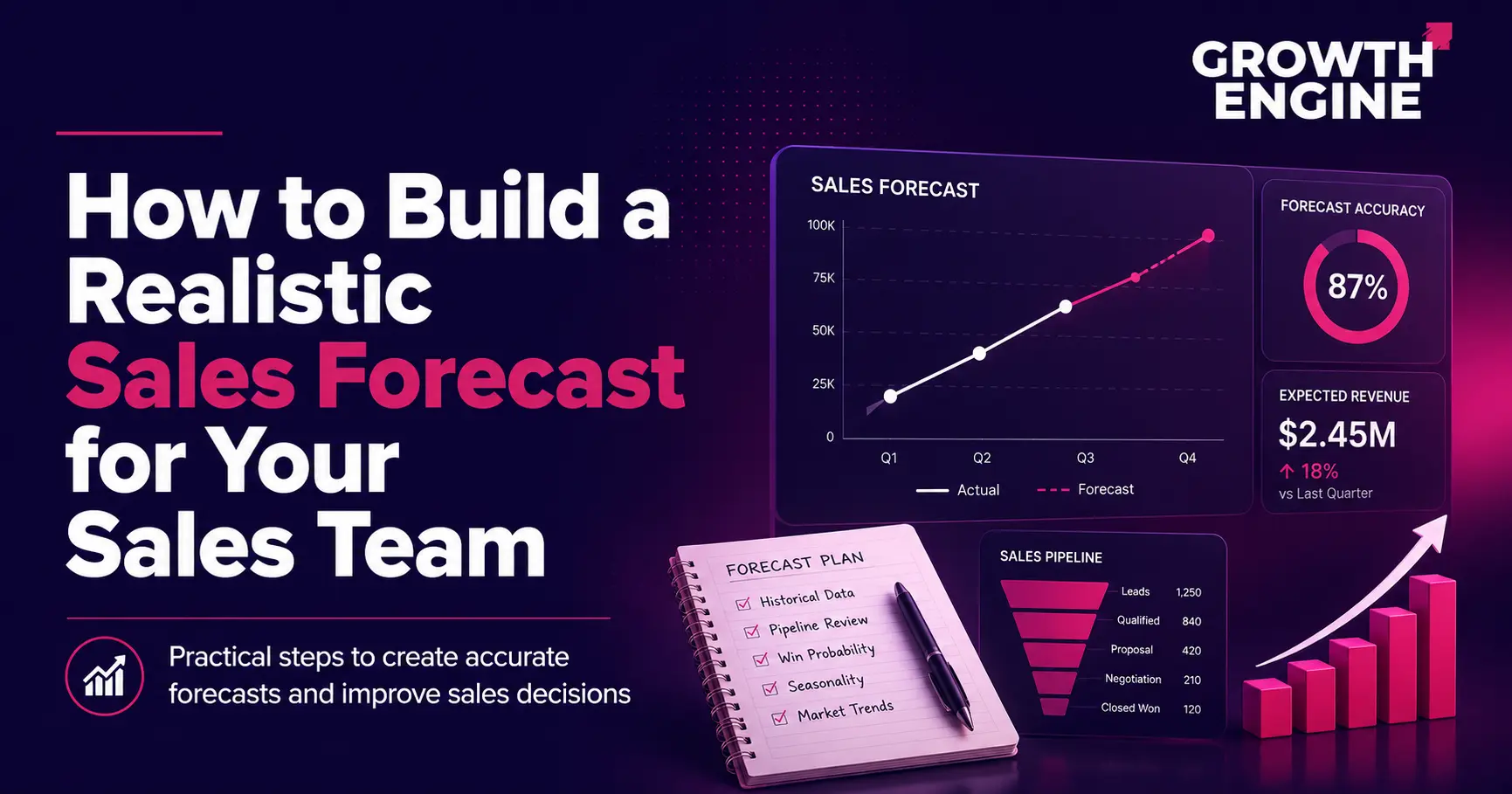
A reliable Sales Forecast is one of the most valuable tools a sales manager can use to make informed business decisions. From setting revenue targets and allocating resources to planning budgets and hiring new sales representatives, nearly every strategic decision depends on the accuracy of sales forecasts.
Yet many organizations still build their forecasts using intuition, optimism, or best-case scenarios rather than objective data. The result is often unrealistic sales targets, missed expectations, poor resource allocation, and unnecessary pressure on sales teams.
An effective sales forecast isn’t about predicting the future with certainty—it’s about estimating future revenue based on measurable data, historical performance, pipeline health, customer behavior, and current market conditions. The more accurate your forecast is, the more confident your business can be when making strategic decisions.
At Growth Engine, we believe successful forecasting begins with understanding the entire sales process—not simply reviewing last month’s revenue. High-performing sales managers combine pipeline analysis, conversion rates, historical trends, and sales performance KPIs to create forecasts that support smarter planning and sustainable business growth.
In this guide, you’ll learn how to build a realistic Sales Forecast, discover the factors that influence forecasting accuracy, avoid common forecasting mistakes, and create a stronger sales plan that helps improve overall sales management performance.
What Is a Sales Forecast?
A Sales Forecast is the process of estimating how much revenue a business is expected to generate during a specific period, such as a month, quarter, or year.
However, forecasting is much more than predicting a revenue number.
It is a structured business process that combines historical performance, current pipeline data, customer demand, and probability analysis to estimate future sales with the highest possible level of accuracy.
Businesses rely on sales forecasts to:
- Set realistic revenue targets.
- Plan hiring initiatives.
- Allocate budgets.
- Manage inventory.
- Support financial planning.
- Measure overall business performance.
The more accurate the forecast, the stronger the business decisions become.
Why Do Sales Forecasts Fail?
Despite their importance, many sales forecasts fail to reflect reality.
The most common reasons include:
- Relying on intuition instead of data.
- Ignoring historical trends.
- Overestimating pipeline opportunities.
- Poor CRM data quality.
- Inconsistent pipeline updates.
- Weak lead qualification processes.
- Lack of measurable sales KPIs.
When forecasting is built on assumptions rather than evidence, sales targets become unrealistic and business planning suffers.
The Foundation of an Accurate Sales Forecast
Before creating any forecast, sales managers should ensure they have access to reliable business data.
1. Historical Sales Data
Historical performance provides the starting point for realistic forecasting.
Review previous:
- Revenue performance.
- Closed deals.
- Average deal value.
- Conversion rates.
- Sales cycle length.
- Seasonal trends.
These insights establish a baseline for future expectations.
2. Pipeline Quality
The number of opportunities alone tells very little.
Managers should also evaluate:
- Opportunity value.
- Probability of closing.
- Current sales stage.
- Expected close date.
- Customer engagement level.
A well-maintained CRM dramatically improves forecasting accuracy.
3. Sales Performance KPIs
Successful organizations build forecasts around measurable KPIs rather than assumptions.
Important forecasting metrics include:
- Win rate.
- Conversion rate.
- Average deal size.
- Pipeline coverage.
- Sales velocity.
- Customer retention.
Together, these KPIs create a far more reliable picture of future performance than revenue alone.
How to Build a Realistic Sales Forecast
Step 1: Define Your Forecast Period
Begin by determining exactly what you’re forecasting.
Examples include:
- Monthly forecasts.
- Quarterly forecasts.
- Annual forecasts.
Each timeframe requires different levels of detail and different planning assumptions.
Step 2: Analyze Market Conditions
Internal sales data is only part of the equation.
External factors also influence future sales, including:
- Market demand.
- Economic conditions.
- Industry trends.
- Seasonality.
- Competitive activity.
- Customer buying behavior.
Ignoring these variables often leads to unrealistic projections.
Step 3: Assign Closing Probabilities
Not every sales opportunity has the same likelihood of closing.
Instead of counting every open opportunity equally, assign a probability based on the stage of the sales process.
For example:
- Initial contact: 10%
- Discovery meeting: 30%
- Proposal submitted: 60%
- Final negotiation: 90%
This probability-based approach creates a much more realistic Sales Forecast.
Step 4: Continuously Review Performance
Forecasting should never be treated as a one-time exercise.
As pipeline activity changes, opportunities progress, or market conditions shift, forecasts should be updated accordingly.
The most successful sales managers review forecasting data weekly rather than waiting until the end of the month.
Best Sales Forecasting Models
There isn’t a single forecasting method that works for every business. The right approach depends on your sales cycle, available data, industry, and company size. However, the following forecasting models are among the most effective and widely used by successful sales organizations.
1. Historical Sales Forecasting
Historical forecasting uses previous sales performance as the foundation for predicting future revenue.
Sales managers analyze historical data such as:
- Revenue trends
- Seasonal performance
- Average deal value
- Sales growth
- Customer demand patterns
This method works well for businesses with stable sales cycles and several years of reliable data.
However, historical forecasting should always be adjusted to account for changing market conditions, new products, or economic shifts.
2. Pipeline Forecasting
Pipeline forecasting estimates future revenue by analyzing every active opportunity in the sales pipeline.
Instead of assuming every opportunity will close, each deal is assigned a closing probability based on its current sales stage.
For example:
- Opportunity value: $20,000
- Probability of closing: 70%
- Forecast contribution: $14,000
Repeating this process across every opportunity produces a far more realistic Sales Forecast than simply totaling pipeline value.
Professionals who want to master pipeline management and data-driven forecasting can benefit from Growth Engine’s Sales Management Mastery program, where practical forecasting frameworks and modern sales management techniques are covered in depth.
3. KPI-Based Forecasting
High-performing sales organizations increasingly rely on measurable sales KPIs instead of intuition.
These metrics include:
- Conversion rate
- Win rate
- Sales velocity
- Average deal size
- Pipeline coverage
- Qualified opportunities
By combining these indicators, sales leaders can identify future revenue trends long before deals are officially closed.
This proactive approach allows managers to make better decisions and respond quickly when performance begins to change.
Common Sales Forecasting Mistakes
Even experienced sales managers can reduce forecast accuracy by making avoidable mistakes.
Overestimating Pipeline Opportunities
One of the biggest forecasting mistakes is assuming every opportunity has a high chance of closing.
In reality, many deals remain in early qualification stages and have relatively low closing probabilities.
Forecasts should always reflect actual opportunity quality—not salesperson optimism.
Ignoring Market Changes
Markets evolve constantly.
Economic conditions, customer demand, new competitors, pricing changes, and seasonal fluctuations all influence sales performance.
Businesses that fail to update their forecasts as conditions change often experience significant forecasting errors.
Looking Only at Revenue
Revenue is an important outcome, but it doesn’t explain why results are changing.
Sales managers should evaluate supporting KPIs such as:
- Conversion rate
- Pipeline health
- Customer acquisition trends
- Average sales cycle
- Sales activity levels
Looking beyond revenue creates a much more reliable forecasting process.
How to Improve Sales Forecast Accuracy
Forecast accuracy improves through consistent review and continuous refinement.
Sales leaders should:
- Update CRM data regularly.
- Review opportunity stages weekly.
- Measure sales KPIs consistently.
- Recalculate closing probabilities.
- Compare forecasts with actual performance.
- Adjust forecasting models using historical insights.
Organizations that continuously refine their forecasting process make better strategic decisions and reduce uncertainty across the business.
The Sales Manager’s Role in Forecasting Success
Technology alone cannot create accurate forecasts.
The quality of every forecast depends on how effectively a sales manager leads the team and maintains reliable sales data.
Sales managers should regularly:
- Review pipeline opportunities.
- Validate CRM accuracy.
- Coach sales representatives.
- Monitor KPI trends.
- Remove pipeline bottlenecks.
- Improve qualification standards.
Managers looking to strengthen leadership and forecasting capabilities can also explore How to Manage a Sales Team and Improve Performance, where practical coaching frameworks, accountability systems, and performance improvement strategies are discussed in greater detail.
Make Sales Forecasting Part of Your Sales Strategy
Forecasting should never exist as a standalone spreadsheet.
Instead, it should become an essential component of your overall sales plan.
Accurate forecasts help organizations:
- Set achievable revenue targets.
- Allocate resources effectively.
- Improve budgeting decisions.
- Plan hiring with confidence.
- Track long-term business growth.
- Support executive decision-making.
To build a complete sales management system that integrates forecasting, KPIs, and strategic planning, explore Sales Management Course: What Does a Professional Sales Manager Learn?, where Growth Engine provides practical frameworks designed for today’s sales leaders.
Conclusion
An accurate Sales Forecast is much more than a revenue estimate—it’s a strategic decision-making tool that helps organizations plan with confidence, optimize resources, and drive sustainable growth. By combining historical data, pipeline analysis, sales KPIs, and continuous performance reviews, sales managers can build forecasts that reflect reality rather than assumptions.
At Growth Engine, we help sales leaders transform forecasting from guesswork into a structured business process. Through our practical training programs, managers learn how to analyze performance, improve forecast accuracy, lead high-performing sales teams, and build scalable sales systems that consistently deliver measurable business results.
Frequently Asked Questions
What is a Sales Forecast?
A Sales Forecast is an estimate of future sales revenue based on historical data, pipeline opportunities, market conditions, and measurable sales performance indicators.
Why is sales forecasting important?
Sales forecasting helps businesses plan budgets, allocate resources, set realistic targets, manage hiring, and make informed strategic decisions.
What makes a sales forecast accurate?
Accurate forecasts rely on clean CRM data, historical trends, pipeline quality, measurable KPIs, and regular updates as market conditions change.
What’s the difference between a sales forecast and a sales plan?
A sales forecast predicts future revenue, while a sales plan outlines the strategies, activities, and actions required to achieve those revenue goals.
Which sales forecasting method is best?
The best method depends on your business, but pipeline forecasting and KPI-based forecasting generally provide the highest accuracy for modern sales organizations.
How often should sales forecasts be updated?
Most businesses should review forecasts weekly and update them whenever significant pipeline changes or market shifts occur.
What role does CRM play in forecasting?
CRM systems provide real-time opportunity data, pipeline visibility, and customer information that significantly improve forecasting accuracy.
Which KPIs are most important for forecasting?
Key forecasting KPIs include win rate, conversion rate, sales velocity, average deal size, pipeline coverage, and customer retention.
Who is responsible for creating sales forecasts?
Sales managers typically prepare forecasts by working closely with sales representatives, CRM data, and executive leadership.
Can small businesses benefit from sales forecasting?
Absolutely. Even small sales teams can improve planning, cash flow management, and business growth by implementing a structured forecasting process.