Currently Empty: EGP0.00
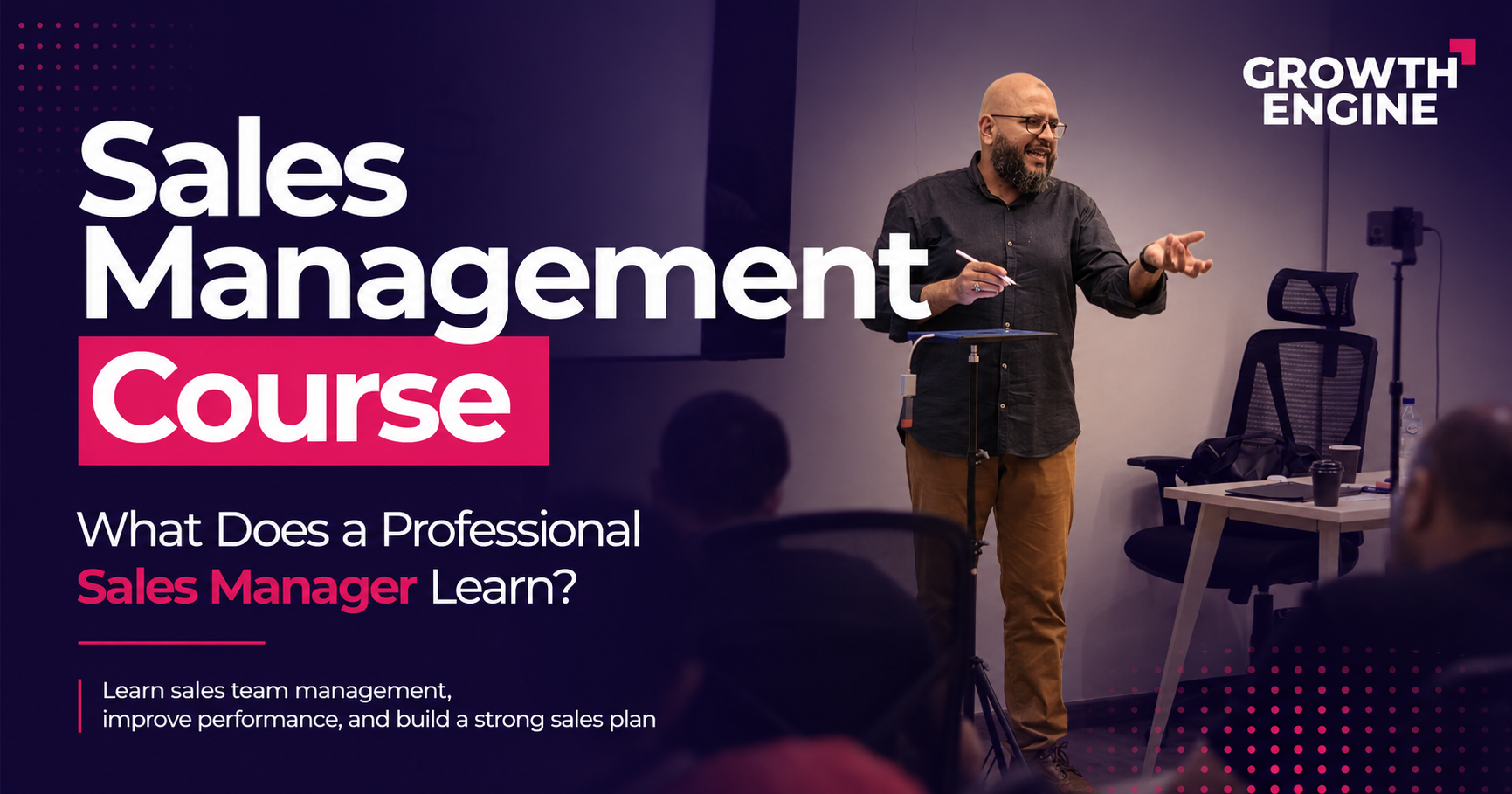
Sales management is not just about tracking numbers or asking the sales team to achieve targets. A professional sales manager needs a clear understanding of the market, the team, customers, goals, the sales plan, performance indicators, and how to deal with every salesperson inside the team. That is why a sales management course has become one of the most important training programs for any sales manager who wants to move from random management to leading a sales team through a clear and measurable system.
In this article, you will learn what a professional sales manager studies in a sales management course, why being a successful salesperson is not enough to become a successful sales manager, and what essential skills are needed to lead a team, improve performance, and achieve better results.
What Is a Sales Management Course?
A sales management course is a training program that helps sales managers, sales team leaders, and business owners understand how to lead a sales team professionally. The course does not focus only on selling itself. Instead, it focuses on managing the complete sales system: planning, selecting salespeople, assigning roles, monitoring performance, analyzing results, motivating the team, and developing the skills of salespeople.
The main goal of a sales management course is to help managers build a sales team that can achieve results consistently, instead of relying on temporary motivation, daily pressure, or unstructured decisions. A professional sales manager does not only ask the team about the numbers; they understand why results were achieved or why they were not achieved, and what action is needed to improve performance.
Why Does a Sales Manager Need Specialized Training?
Many companies promote their best salesperson to the position of sales manager. However, success as a salesperson does not necessarily mean that the person is ready to manage a team. A successful salesperson usually depends on personal skills in communication, persuasion, follow-up, and closing deals. A sales manager, on the other hand, needs broader skills that include leadership, planning, analysis, training, motivation, and problem solving.
This is where the importance of sales manager training becomes clear. A new manager may know how to sell, but may not know how to make others sell. They may know how to deal with a customer, but may not know how to deal with an underperforming salesperson, an unmotivated team, or an unrealistic sales plan.
A sales management course helps the manager understand their real role. They are not just a supervisor, and they are not just someone who transfers pressure from upper management to the sales team. They are responsible for building a clear sales environment and turning company goals into daily activities that can be executed and measured.
What Does a Professional Sales Manager Learn in a Sales Management Course?
A professional sales manager learns a set of skills that help them lead the sales team and improve results in a practical way. Below are the most important areas covered in a sales management course.
1. Understanding the Real Role of a Sales Manager
The first thing a sales manager needs is to understand the nature of their role. Many managers believe that their main responsibility is to ask the team for numbers, but the real role is much deeper. A sales manager is responsible for building a plan, guiding the team, monitoring execution, removing obstacles, training salespeople, and improving results.
A professional sales manager asks different questions: Is the team targeting the right customers? Is the sales presentation suitable? Do salespeople know how to handle objections? Is follow-up happening at the right time? Are the targets realistic? Is there a problem with the quality of leads, or is the problem in the team’s skills?
These questions make management based on analysis, not assumptions. This is where the difference begins between a manager who only pressures the team and a manager who leads the team toward better results.
2. Analyzing the Current Sales Situation
Before creating any plan, a sales manager needs to understand the current situation of the team. That is why, in a sales management course, the manager learns how to analyze sales results, strengths, weaknesses, available opportunities, and threats that may affect performance.
This analysis may include the number of leads, the quality of sales opportunities, conversion rate, average deal size, sales cycle length, the performance of each salesperson, lead sources, and reasons for lost deals. This data helps the manager see the full picture instead of focusing only on the final sales number.
For example, if sales are low, the problem may not be the team’s ability to close deals. The real issue may be a lack of leads, poor lead qualification, an unclear offer, or weak follow-up. That is why no correct decision can be made without accurate analysis.
3. Building a Clear Sales Plan
One of the most important things a sales manager learns in the course is how to build a clear sales plan. A sales plan does not mean simply writing a target number at the beginning of the month. It means defining the practical path needed to reach that number.
A good sales plan includes the target market, customer segments, priority products or services, team goals, individual salesperson goals, required daily activities, lead generation channels, follow-up process, performance indicators, and a plan for dealing with deviations from the target.
Without a clear plan, the sales team becomes a group of people working separately, each in their own way. A plan helps the team move in one direction and allows the manager to measure performance and identify areas for improvement.
4. Preparing a Sales Forecast
Sales forecasting is one of the most important tools of a professional sales manager. It helps the manager understand the expected results during a specific period based on existing opportunities, not only on hopes or optimism.
In a sales management course, the manager learns how to build a realistic sales forecast by tracking sales opportunities, sales stages, closing probability, deal value, expected closing date, and previous salesperson performance. This information helps management make better decisions regarding resources, campaigns, hiring, or adjusting targets.
A good sales forecast is not only used to predict results. It also reveals where the problem exists. If the number of opportunities is low, the problem is in lead generation. If there are many opportunities but the closing rate is weak, the problem may be in presentation skills or objection handling. If deals are delayed, the issue may be follow-up or the customer’s decision-making cycle.
5. Structuring the Sales Team and Assigning Roles
Managing a sales team requires a clear structure. Not everyone can work in the same way or do everything without defined responsibilities. That is why a sales manager learns how to define the right team structure according to the company, market, and customers.
The team may need salespeople responsible for new customers, others responsible for follow-up, others responsible for managing existing accounts, or a specialized team for real estate sales or corporate sales. The important thing is that every person knows their role, responsibilities, and performance indicators.
Clear roles reduce overlap, prevent lost opportunities, and make performance evaluation fairer. When every salesperson knows what is expected from them, it becomes easier to measure and develop their performance.
6. Selecting and Hiring the Right Salespeople
One common mistake in companies is hiring salespeople based only on personal impressions. However, a professional sales manager knows that choosing the right salesperson requires clear criteria. That is why a sales management course covers how to evaluate candidates, conduct sales interviews, and understand whether a person is suitable for the product, market, and customer type.
The right salesperson is not only someone who speaks well. They may need discipline, follow-up ability, customer understanding, the ability to handle rejection, listening skills, and willingness to learn. In some sectors, such as real estate sales or corporate sales, the salesperson needs patience, professionalism, and the ability to build trust over a longer period.
Choosing the wrong person costs the company time, opportunities, and money. That is why proper hiring is one of the most important responsibilities of a sales manager.
7. Training and Developing the Sales Team
A professional sales manager does not expect the team to improve without training. Even a good salesperson needs continuous development in communication skills, understanding customer needs, presenting value, handling objections, follow-up, and negotiation.
Inside a sales management course, the manager learns how to identify the training needs within the team. Is the problem at the beginning of communication? Does the salesperson fail to ask enough questions? Do they explain the product too generally? Do they lose the customer when there is a price objection? Do they follow up too late? Each problem needs a different type of training.
Good training is not just a theoretical lecture. It should be connected to real situations the team faces. That is why it is important for the manager to use meetings, call reviews, role-playing, and deal analysis as tools to develop the team.
8. Leading and Motivating the Sales Team
Leading a sales team is different from simply managing tasks. Salespeople face rejection, pressure, comparisons, customer objections, and delayed decisions every day. That is why a sales manager needs a leadership style that helps the team continue and improve performance.
In a sales management course, the manager learns how to balance follow-up and motivation. Constant pressure without support leads to loss of motivation, while support without accountability leads to weak commitment. A professional manager knows when to guide, when to train, when to hold people accountable, and when to motivate.
The manager also learns that each salesperson may need a different approach. One salesperson may need training, another may need clearer goals, another may need closer follow-up, and another may need bigger challenges. Effective leadership starts with understanding the people inside the team.
9. Tracking Sales Performance Indicators
Sales performance cannot be improved without measurement. That is why a sales manager learns how to identify and monitor the right sales performance indicators. Examples include the number of leads, number of meetings, number of proposals, conversion rate, deal value, closing rate, average sales cycle length, and target achievement percentage.
However, the important thing is not only collecting numbers, but understanding what they mean. If a salesperson contacts a large number of customers but does not generate sales, the problem may be in the quality of communication or qualification. If they have many proposals but few closed deals, the problem may be in objection handling or value presentation. If there are too few opportunities from the beginning, the problem may be in lead sources or daily activity.
Performance indicators help the sales manager make accurate decisions instead of relying on a general feeling that performance is good or bad.
10. Dealing With Weak Performance
One of the most difficult responsibilities of a sales manager is dealing with an underperforming salesperson. Some managers only apply pressure or threats, but this does not always solve the problem. A professional sales manager starts by diagnosing the real cause.
Does the salesperson not understand the product? Do they not know how to ask the customer the right questions? Are they afraid of closing? Do they fail to follow up with customers at the right time? Do they have a time management problem? Is the market itself weak? Are the leads they receive not suitable?
After identifying the cause, the manager can create the right corrective action. This may include training, closer follow-up, changing the sales territory, improving lead quality, changing the presentation method, or in some cases making an administrative decision if there is no improvement.
What Is the Difference Between an Ordinary Sales Manager and a Professional Sales Manager?
An ordinary sales manager often focuses only on the final result: did the team achieve the target or not? A professional sales manager focuses on the system that creates the result. They track activities, opportunity quality, team skills, performance indicators, and reasons behind success or failure.
An ordinary manager may blame the team when results are weak. A professional manager analyzes the problem and searches for the real cause. An ordinary manager waits until the end of the month to know the result. A professional manager monitors indicators during the month so they can intervene at the right time. An ordinary manager depends only on the best salespeople. A professional manager builds a system that improves the performance of the entire team.
Who Needs a Sales Management Course?
A sales management course is suitable for more than one group inside companies, especially people responsible for leading or improving sales performance. The most important groups that need this training include:
- New sales managers who moved from a salesperson role to a management role.
- Experienced sales managers who want to develop their management style.
- Sales supervisors and sales team leaders.
- Business owners who manage internal sales teams.
- Branch managers or commercial department managers.
- High-performing salespeople who are being prepared for a management role.
- Companies that struggle to achieve sales targets.
- Teams that need a clear system for follow-up and performance improvement.
How Does a Sales Management Course Help Improve Team Performance?
A sales management course helps improve team performance because it gives the manager practical tools to understand and improve the problem. Instead of treating weak results as just a negative number, the manager learns how to read performance through data, behaviors, and activities.
When the manager understands the reasons behind declining performance, they can make better decisions. The team may need training on objections, better value presentation, organized follow-up, an adjusted sales plan, or redistribution of targets. Every decision becomes stronger when it is based on clear analysis.
The course also helps improve communication between the manager and the team. A salesperson needs a manager who guides, supports, and holds them accountable clearly — not a manager who only asks for results. This type of management increases commitment and helps the team develop.
Is a Sales Management Course Useful for Business Owners?
Yes, a sales management course is very useful for business owners, especially in companies that depend on a sales team to grow. A business owner may have a good product or a strong service, but weak sales management can lead to many lost opportunities.
When a business owner understands the basics of sales management, they can evaluate their team’s performance better, choose the right sales manager, build realistic goals, and monitor results through clear indicators. They can also distinguish between a market problem, a product problem, a team problem, and a management problem.
How Do You Choose the Right Sales Management Course?
When choosing a sales management course, do not look only for an attractive title. Look for a practical program that clearly explains the responsibilities of a sales manager and connects planning, execution, and performance measurement. The right course should help you deal with real challenges such as weak salespeople, missed targets, difficulty in forecasting, poor follow-up, and inconsistent results.
It is also better for the course to be suitable for the Arab market, because managing sales teams differs according to customer culture, decision-making style, business sectors, and common selling methods. That is why you need training that combines management concepts with practical applications.
How Can Growth Engine Academy Help You?
Growth Engine Academy provides practical sales training programs in Arabic that help individuals and companies develop selling skills, manage sales teams, and improve commercial performance. Through the Professional Sales Management Course, a sales manager learns how to lead the team in a more organized way, create a clear plan, monitor performance, develop salespeople, and deal with the challenges of achieving targets.
To explore other training programs, you can visit the Courses page and choose the right program for you or your team. You can also book a course or contact us through the Contact Us page to find out which program best fits your needs.
Conclusion
A sales management course helps a sales manager move from simply tracking numbers to leading a complete sales system. A professional manager does not rely only on pressure. They use planning, analysis, training, motivation, and performance measurement to improve results.
If you are a sales manager, team leader, or business owner, learning sales management professionally can help you build a stronger team, reduce mistakes, improve follow-up, and increase the chances of achieving sales goals consistently.
Frequently Asked Questions About Sales Management Courses
1. What is a sales management course?
A sales management course is a training program that helps sales managers and sales team leaders learn how to plan sales activities, lead the team, monitor performance, analyze results, and improve the team’s ability to achieve sales targets.
2. What does a sales manager learn in a sales management course?
A sales manager learns how to build a sales plan, prepare a sales forecast, manage a sales team, track performance indicators, train salespeople, motivate the team, deal with weak performance, and make decisions that improve sales results.
3. Is a sales management course suitable for new managers?
Yes, a sales management course is suitable for new managers because it helps them understand the difference between the role of a salesperson and the role of a sales manager. It also gives them practical tools for leading the team, assigning targets, monitoring performance, and dealing with daily sales problems.
4. Does a successful salesperson need sales management training before promotion?
Yes, because selling skills are different from sales team management skills. A successful salesperson needs to learn leadership, planning, analysis, training, motivation, and performance tracking in order to succeed as a sales manager.
5. How does a sales management course improve team performance?
A sales management course improves team performance by teaching the manager how to analyze results, identify the causes of weak performance, create a clear plan, monitor performance indicators, train salespeople, and apply suitable corrective actions.
6. What are the most important skills of a professional sales manager?
The most important skills of a professional sales manager include planning, team leadership, data analysis, sales forecasting, motivating salespeople, training the team, managing meetings, monitoring performance indicators, and dealing with sales problems practically.
7. Is a sales management course useful for business owners?
Yes, a sales management course is useful for business owners because it helps them understand how to build an effective sales team, monitor results, choose the right sales manager, evaluate team performance, and improve the company’s sales system.
8. When does a company need sales management training?
A company needs sales management training when it struggles to achieve targets, lacks a clear sales plan, has weak team follow-up, experiences inconsistent results, loses many deals, or does not have a clear system for evaluating and improving salesperson performance.