Currently Empty: EGP0.00
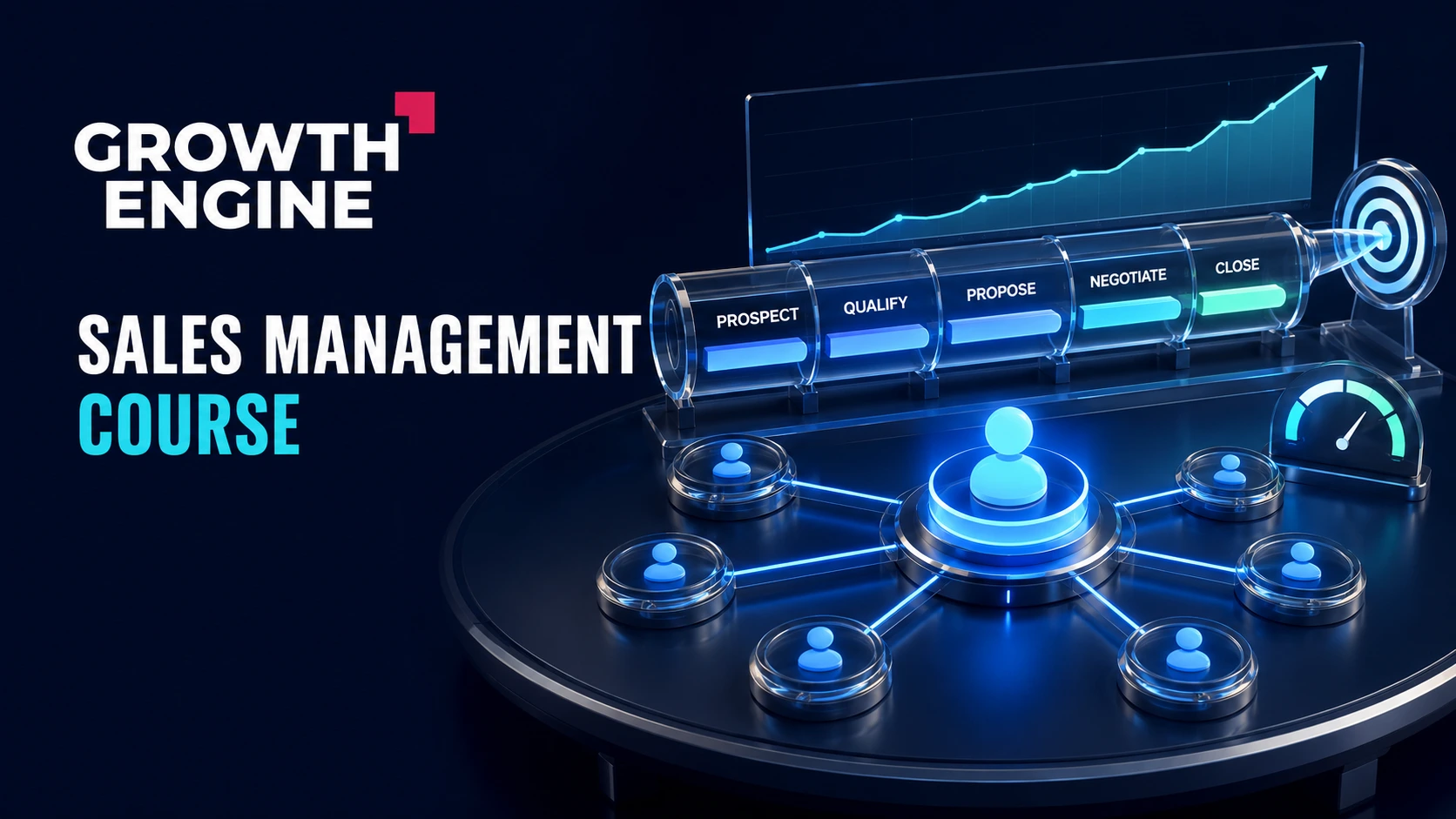
Sales Management Course: What Should a Professional Sales Manager Learn?
Sales management is not checking the numbers at the end of the month. It means building a plan, team, pipeline, and management rhythm that produces results you can understand and improve.
Reading time: 12 minutesLevel: Team leader and managerTopic: Sales management
Being a successful salesperson does not automatically make you a successful sales manager. A salesperson owns individual opportunities and deals. A manager must build a system that enables the whole team to perform through clear goals, suitable roles, a measurable pipeline, continuous coaching, and early intervention when results move off course.
What is sales management?
Sales management is the process of planning, organising, leading, and monitoring sales activity to achieve the company's commercial objectives. It includes setting goals, allocating territories or accounts, managing the pipeline, forecasting, reviewing performance, and developing salespeople.
A manager's contribution is not measured by the number of meetings or reports produced. It is measured by the ability to turn company strategy into clear daily behaviour and measurable team outcomes.
A strong sales manager does not become the team's hero. They build a team that can win repeatedly.
Salesperson vs sales manager
| Salesperson | Sales manager |
|---|---|
| Manages personal opportunities and customers | Manages the system used by the team |
| Focuses on an individual target | Balances the team target with individual capacity |
| Executes the sales process | Designs the process and monitors adoption |
| Handles individual objections | Coaches recurring patterns across the team |
| Reviews personal deals | Analyses pipeline, forecast, and risk |
| Receives coaching | Delivers coaching and measures its effect |
When do you need a sales management course?
- You were promoted from seller to team leader
- The team relies on you to close every deal
- There is no standard sales process
- Forecasts repeatedly miss the actual result
- Meetings create updates but no decisions
- Targets are not translated into daily activity
- Performance varies widely across the team
- You cannot see where opportunities stall
The training can also suit business owners who personally manage sales teams and team leaders preparing for broader responsibility.
What should you learn in a sales management course?
Sales planning
Translate annual objectives into periods, segments, activities, and assumptions that can be monitored.
Sales-process design
Define stages, exit criteria, and standards that create consistent work and reliable data.
Pipeline management
Assess the quality, volume, balance, and velocity of opportunities rather than total value alone.
Sales forecasting
Build forecasts from stages, probability, and evidence instead of optimism or pressure from leadership.
Team leadership
Set expectations, distribute responsibility, and build discipline, trust, and accountability.
Sales coaching
Turn performance reviews into focused development of a specific skill or behaviour.
Performance metrics
Choose KPIs that reveal execution quality before the final revenue number arrives.
Sales meetings
Convert meetings into decisions, owners, deadlines, and action rather than lengthy status updates.
How does a sales manager build a practical plan?
Define the objective and assumptions
Clarify the required revenue, customers, or units, the period, markets, and average deal size.
Work backwards into activity
Estimate the deals, qualified opportunities, conversations, and leads required using realistic conversion rates.
Allocate responsibility
Distribute quotas, accounts, or territories according to capacity and available opportunity.
Monitor leading indicators
Track activity, conversion, quality, and velocity before a shortfall appears at month end.
Adjust using evidence
Change priorities, resources, process, or training when the data exposes a clear bottleneck.
How to manage a sales pipeline correctly
A pipeline should not be a list of everyone the team has contacted. Each stage must represent genuine progress supported by clear criteria.
| Management question | What it reveals |
|---|---|
| Is the opportunity genuinely qualified? | Whether need, fit, timing, and decision access exist |
| What evidence supports the current stage? | The difference between progress and opinion |
| What is the next step and date? | Whether the opportunity is moving or stalled |
| How long has it remained in this stage? | Delay, weak follow-up, or process friction |
| Why is it expected to close? | Forecast quality and risk |
Adding weak deals does not solve a pipeline gap. A large pipeline full of unqualified opportunities creates false confidence and unreliable forecasts.
Essential sales-team KPIs
No single KPI fits every business. Managers need a balanced view of outcomes, execution, and quality.
- Revenue and quota attainment
- Deal count and average deal size
- Stage-to-stage conversion
- Sales-cycle length
- Pipeline coverage
- Qualified-opportunity rate
- Forecast accuracy
- Reasons for lost deals
Do not use metrics only for punishment. A KPI should lead to diagnosis and action: coaching, process improvement, better lead quality, or removing an obstacle.
How should a manager coach a sales team?
Coaching does not mean providing the answer every time. Its purpose is to help the salesperson understand performance and develop a better approach that can be repeated.
- Select a specific situation or skill instead of judging personality.
- Ask the salesperson to assess what happened first.
- Use evidence from a call, deal, or performance data.
- Agree on one behaviour to practise and improve.
- Set a date to review application and results.
Replace “You need to close more” with “Let's review the last three opportunities that stalled after the proposal and identify the question we failed to ask before presenting price.”
Which sales meetings does a team need?
Not every issue needs another meeting. Use a simple rhythm that supports decisions:
- Short team meeting: priorities, obstacles, and commitments.
- Pipeline review: opportunity quality, next steps, and risk.
- One-to-one: performance, development, and individual support.
- Forecast review: expected outcomes, evidence, and scenarios.
- Coaching session: one skill or realistic situation.
How to choose the right sales manager training
- Define the challenge: leadership, planning, pipeline, forecasting, or coaching?
- Review the curriculum: does it include usable tools and models or theory only?
- Look for application: cases, exercises, and discussion of realistic situations.
- Check the trainer's experience: in selling, management, and training.
- Plan the first 30 days: what will you apply and measure after the course?
Move from monitoring results to building a sales system
Growth Engine Academy presents Sales Management Professionalism as practical training for managers and team leaders who want to strengthen planning, leadership, and performance management. The programme is delivered by Ahmed Khalifa, a sales consultant and trainer with more than 21 years of stated experience.
Explore Sales Management ProfessionalismConclusion
A professional sales manager does not wait until month end to discover the result. They connect objectives to activity, build a clear process, monitor the pipeline, develop people, and intervene using evidence.
Choose a sales management course that helps you apply these responsibilities inside your team, then begin with one measurable change instead of attempting to rebuild everything at once.
Frequently asked questions
What is a sales management course?
It is training that helps sales managers and team leaders develop planning, pipeline management, forecasting, leadership, performance monitoring, and coaching skills.
Who needs sales management training?
Sales managers, team leaders, salespeople preparing for promotion, and business owners who directly manage a sales team.
What is the difference between a sales manager and team leader?
Responsibilities vary by company, but a team leader often focuses on daily execution, while a manager usually owns broader planning, targets, resources, and forecasting.
What are the most important sales manager skills?
Planning, analysis, leadership, pipeline management, forecasting, coaching, decision-making, and communication.
Does a sales manager need to be the best salesperson?
Sales experience helps, but management requires additional skills. The strongest individual seller is not automatically the best person to plan, coach, and lead others.